

Chat GPT Can't Replace Me...Right?
My English degree will not go down in vain. IDC how "unc" that sounds.

It was lunchtime, around 1:00 p.m.
After finishing my food, I roamed around the classroom, trying to contain the endless clutter. Like always, small groups of students arrived with their take-out bags and settled in to eat. Pretending not to be jealous of their McDonald’s fries, I walked past a pair of girls to grab some books and then return to my desk—until a stray piece of gossip stopped me in my tracks.
Student 1: “I was texting my ex yesterday, and he was being so rude, telling me how I was such a bad girlfriend.”
Student 2: “That’s so mean. How were you a bad girlfriend?”
Ok, not my business. I began quickly stacking books.
Student 1: “So, to be fair, he brought up those ChatGPT letters I wrote him.”
…..What? I slowed my book-stacking pace.
Student 2: “What are you talking about?”
Right...
Student 1: “Remember how he always complained that I never did cute things for him and he always did them for me? After all that, I wrote him a few letters. Well, Chat GPT wrote them.”
I raised my eyebrows in surprise, collecting the last of the books, then slipping away. A ChatGPT-written love letter? Actually, love letters? Xoxo, Chat GPT.

As an English teacher, a lover of hand-written notes, and a hopeless romantic, the idea of a bot-written love letter is, frankly, treasonous. Of course, not everyone holds the same ideals (why can’t we write our own emails anymore? I digress); however, something about the idea of having Chat GPT write such a personal note seems wrong.
Nevertheless, I tried to refrain from judging my student (and not just because she eventually offered me some fries). Throughout my career, I’ve become increasingly aware of how often students are exposed to, and then tempted by, ChatGPT and other forms of AI. And, in getting to know my students, I understand why it’s hard to resist that temptation.
When I asked some students about it, one noted that if ChatGPT can make a study guide for them, it gives them more time to actually study it (fair enough). Another shared that if they can’t understand their math homework and their parents aren’t at home, Chat GPT helps them tackle it (that one gave me harrowing flashbacks to my Dad trying his best to help me with algebra after he got home from work; maybe Chat GPT could have gifted him a few extra hours of sleep). All the students that I asked seemed to agree—the primary draw is that it helps them get stuff done.
Chat GPT is an answer to too much homework, to a lack of confidence, to not knowing how to write a thesis, to needing more sleep, to balancing work and school, to craving more time with family and friends, and, in the case of the love letter, to not knowing how to articulate emotions. Ultimately, my students see it as a way to make their lives, which can be unbelievably heavy, slightly lighter.
And that’s ok. As their teacher, I don’t want to make them feel guilty or ashamed for using their resources; I want them to see what they’re leaving behind, not just what they gain, when they choose it.
Admittedly, it’s hard for me to separate my personal bias from my opinion of ChatGPT. Maybe I’m resentful because my high school (and college) years included frequent nights of burning the midnight oil, almost until sunrise, to finish essays. I still feel slightly nauseous as I remember the sky getting lighter and my essay not getting any longer.
Typically, I’d be surrounded by stacks of scribbled, disjointed handwritten drafts, random post-its of ideas, empty mugs, and snack wrappers. When all hope seemed lost, and 5 am grew nearer, something would split in my imagination, and I’d know exactly what to write. Emerging from the ashes, I’d bang out my best work, typing nonstop before changing the font to Times New Roman with a flourish and hitting print.
Would I recommend this approach to my students? Honestly…yes. Not the lack of sleep, but the process of having to build, and then rebuild—to think, then reconsider. To rephrase. To state, pause, and wonder. To chase a spark and write nonstop, then pull back and take inventory of the progress. That process is so necessary in our ability to find the intersection of originality and skill, no matter the field. Chat GPT robs us of that. I can feel the difference between going through that process and just having Chat GPT do it for me (because yes, of course, I’ve tried it- the temptation is real). There’s a bit of relief, but there’s also a lot of dissatisfaction and a sense of isolation from my own mind.
For a while, I wondered why my students didn’t see it that way, too, and at first wrote it off as a generational divide. I thought that over a decade younger than me, and with an education shaped so differently than mine by technology (thanks, COVID!), maybe my students don’t yet have the hindsight to fully see how important that painful, uncomfortable thought process is.
I think this is partially true; however, it’s too easy of an explanation. As I like to endlessly remind my students when they call me “unc,” we are mostly from the same generation. And, as I mentioned before, so many of my peers - family members, friends, colleagues - use it, too. So why am I on my high horse about this?

In order to be successful at my job, whetherin lesson planning or leaving feedback, I’m obligated to think about the learning process. How can I connect students to their minds? I have to try and fail to give them opportunities to learn from themselves and investigate their own responses to literature. Chat GPT jeopardizes students’ motivation to invest in that process.
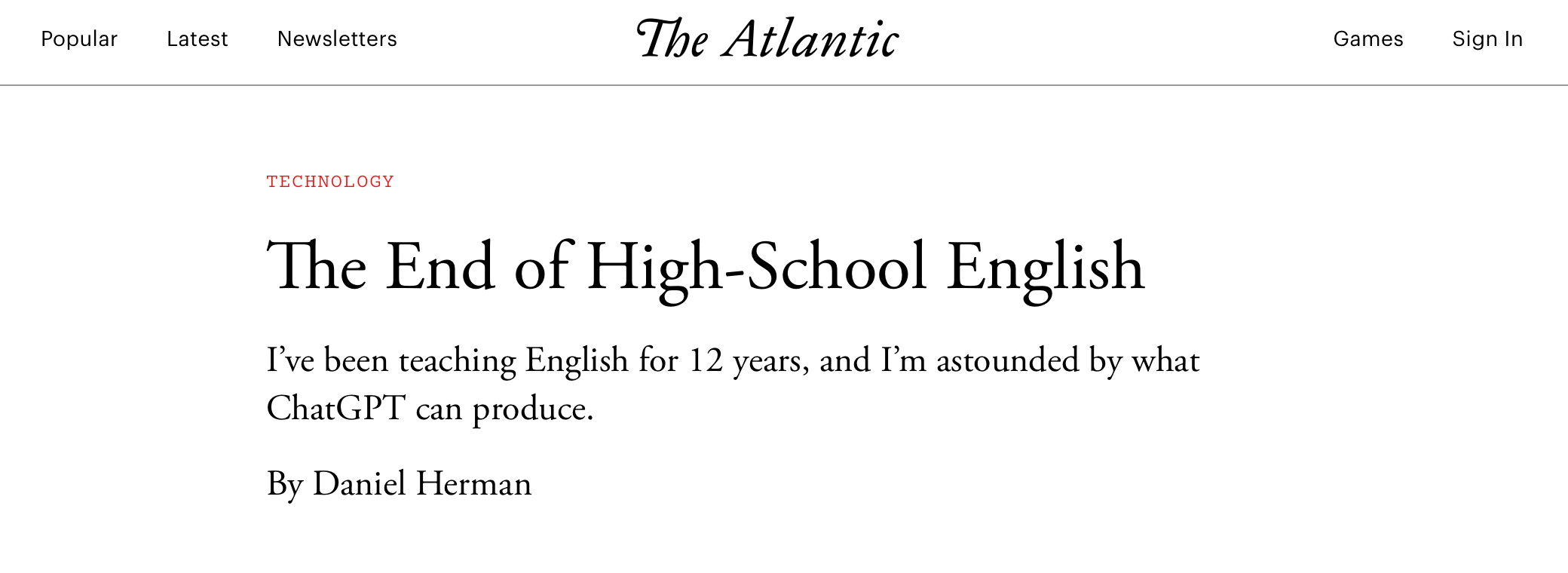
When I was in graduate school, one of my professors shared an article called “The End of High School English.” The ominous report details the emergence of ChatGPT and the threat it poses to classrooms. The author’s greatest fear is that ChatGPT could make students question whether writing is worth doing. To me, that question also becomes, is it worth it to develop your own voice?
I try to tell them that it is, but I end up sounding like a broken record. So I’ve changed my approach and brought back loose-leaf paper, pens, pencils, and tech-free lessons. Naturally, students aren’t jumping for joy over this change. When I assign paragraphs and say that they must be handwritten, in class, I’m met with a symphony of complaints. “Typing is so much faster!” “I don’t like handwriting.” “Why can’t I just do it at home?” Sometimes, I share the latter sentiment with them. More writing at home means more time in class for everything else. However, in addition to the defense against ChatGPT, writing during school rewards us with some real classroom magic.
Once they’ve passed the initial few minutes of tapping their feet and watching the clock, the room softens into silence and then fills with the sound of pens and pencils scratching on paper. In whispers, they ask for feedback on what they’ve written, and we can confer on the spot. When we discuss face-to-face, I can address their confusion or watch their eyes light up with understanding.
In another tech-free tactic, every Friday, class starts with a ten-minute handwritten journaling session. At least one student, every week, will say “again?” when they walk in, and I’m like, “Yes, again.” We do this every week. Journals were painful for them at first, and many students only got a few sentences written down. Now, though, almost everyone fills a page, and when the timer runs out, many are still scribbling.
These sessions are one of my favorite parts of the week. My co-teacher and I create prompts that range from silly to content-related to imaginative to deeply personal. When the ten minutes are up, we invite students to share. Sometimes only one or two will offer a tidbit, while at other times the room erupts into dialogue and story-sharing. In my experience, less technology has meant more opportunities to build community in class.
They all have the capability to pursue their aspirations, but I know that they don’t all see it, and I want to do everything I can to get them there. If that means making Chat GPT my enemy, so be it.
To be clear, I don’t believe that technology has no place in education. In fact, it can have game-changing effects for certain students—but that’s a whole other can of worms.
All I know is that in English class, minimizing technology lends more exposure to one’s thought process, and that’s what I want my students to experience. I hope that by separating them from ChatGPT, they will see how capable they are of following through on their ideas, persevering through writer’s block, and recognizing and unleashing the infinite creativity and knowledge that I know they contain.
During a recent discussion, one student proclaimed that she would never use ChatGPT. She said, “I don’t want to manipulate my mind into thinking I can’t do things on my own.” Automatic A for her, obviously.
In all seriousness, that student’s opinion addresses my biggest fear as an educator: that my students will think that they can’t do things themselves. They all have the capability to pursue their aspirations, but I know that they don’t all see it, and I want to do everything I can to get them there. If that means making Chat GPT my enemy, so be it.
Outside of English class, my students will have to manage the growing presence of AI on their own, just as I do as an adult. If they end up using it for an email or a spreadsheet here and there, so they can create more time for the things that matter, who am I to judge? As long as they know that when it comes to writing a love letter, nothing beats the old school approach, and I’d suggest turning to Shakespeare instead.
 | A guest post by
|
next, we need to hear the drama on how the boyfriend discovered the love letters were written by chatgpt...
I love this and the collab!♥️